
Trinitite: The Strange Green Glass Created by an Atomic Bomb
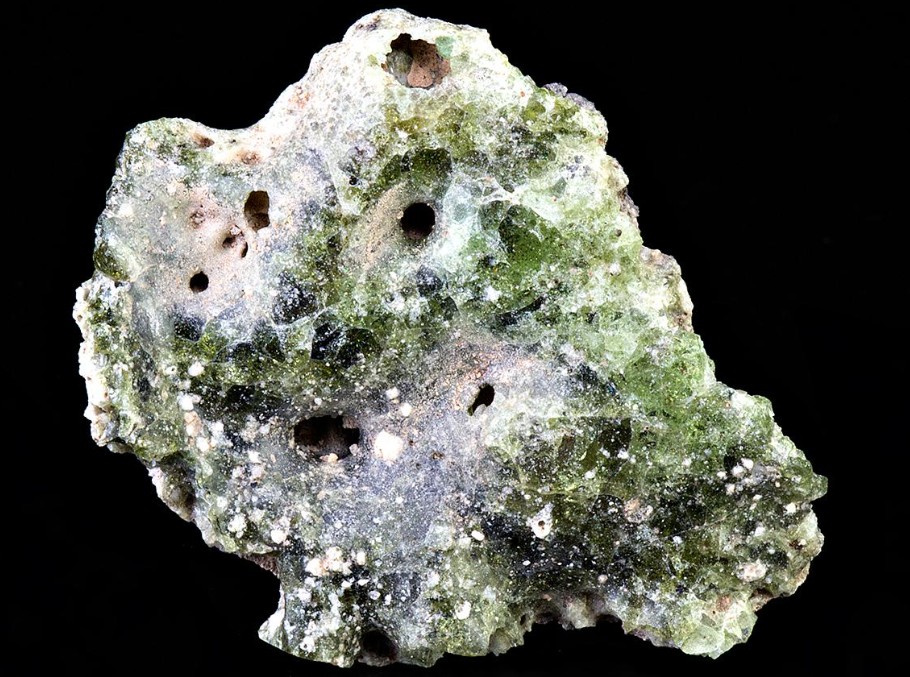
Trinitite is a rare glass formed by the first atomic bomb test. It happened in the New Mexico desert in July 1945. Most pieces are pale green, with rough surfaces and tiny holes. They look like stones found beside an old road. Yet no ordinary fire made them. A single explosion changed desert sand into something new. Some pieces even hold traces of the bomb itself. How did this happen? And why do scientists still study this strange glass more than 80 years later?
Key Points
- Trinitite formed when the world’s first atomic bomb test melted desert sand in New Mexico in 1945.
- Most pieces are pale green, but some are red and contain metals from the test equipment.
- Scientists discovered a rare crystal inside red trinitite, adding to its mystery.
- Trinitite still helps researchers study nuclear explosions and understand the beginning of the atomic age.
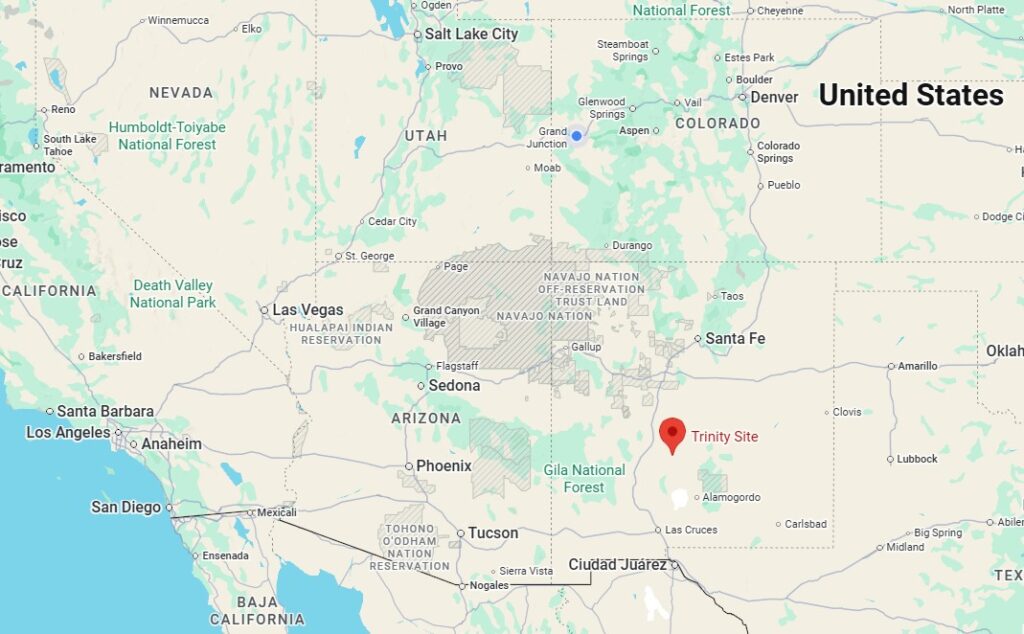
Map: Google Maps
How Trinitite Formed in the New Mexico Desert
Trinitite formed when the Trinity atomic test melted desert sand on July 16, 1945. The blast swept sand into a great ball of fire. Most of it melted and fell back as glass. The place was the Jornada del Muerto desert in New Mexico. Before dawn, workers had raised a bomb onto a steel tower. The tower stood about 100 feet high. Scientists called the bomb “Gadget.” They wanted to learn whether their new design would work. No one had ever tested an atomic bomb before.
At about 5:29 that morning, the bomb exploded. A bright flash lit the desert. Heat and pressure tore through the air. The steel tower was destroyed. Sand, dust, and bits of equipment rose into the fireball. Some of this material cooled as it fell. It formed a thin, uneven layer of glass on the ground. The glass later took its name from the test: Trinity. Scientists are still studying exactly how its different layers formed. Even this simple-looking substance holds clues about those few violent seconds.
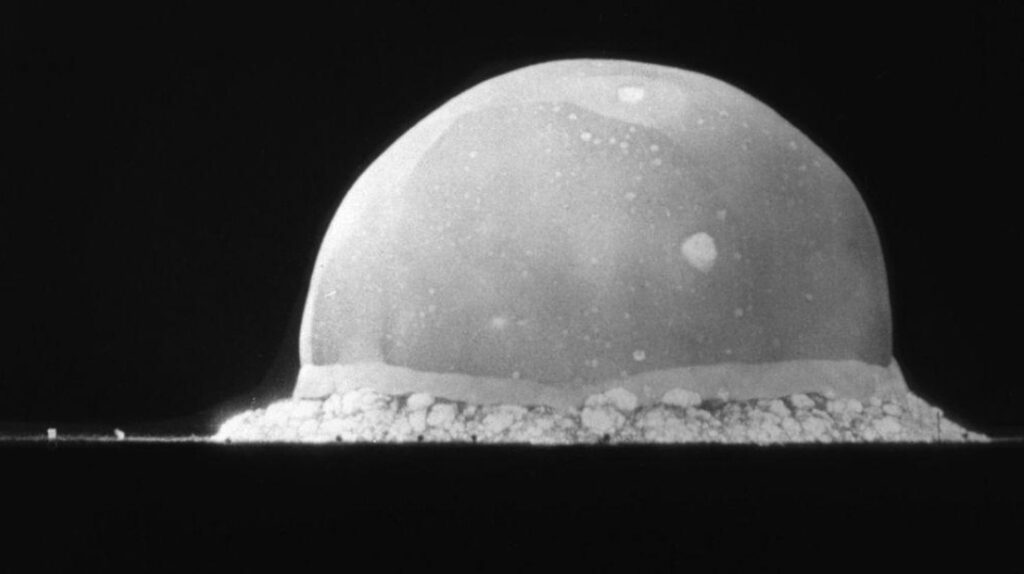
Photo: Berlyn Brixner / Los Alamos National Laboratory
Why Trinitite Is Green, Red, and Full of Holes
Most trinitite looks pale green because it formed mainly from desert sand. But not every piece looks the same. Some are gray, dark, or even red. A piece may have a smooth top and a rough bottom. Tiny holes mark places where gas became trapped. Other pieces contain grains of sand that never fully melted. Each fragment is a record of heat, motion, and sudden cooling.
The red pieces offer another surprise. Scientists found copper and other metals mixed into some of them. Much of that metal came from wires and equipment at the test site. In 2021, researchers reported a rare crystal inside red trinitite. Its atoms follow an unusual pattern. Scientists call it a quasicrystal. Such crystals can form under great heat and pressure. Some have also been found in meteorites. The discovery made trinitite more than a strange souvenir. It became a way to study conditions that are hard to create in a laboratory. A small piece of glass could reveal what happened inside a giant fireball.
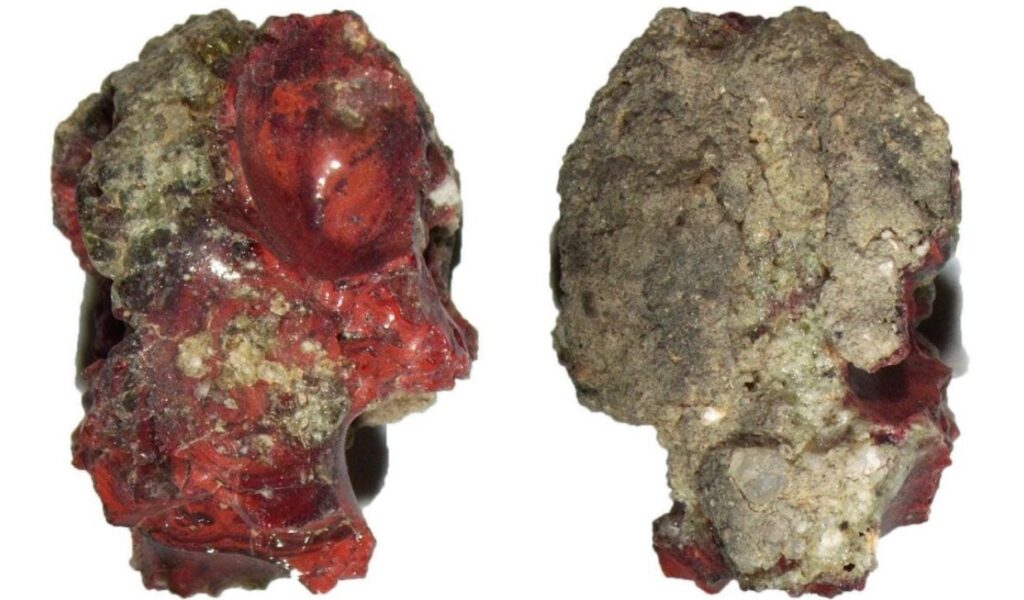
Photo: Luca Bindi and Paul J. Steinhardt / EurekAlert
What Happened to the Trinitite After the Test?
Most of the trinitite was removed or buried after the Trinity test in New Mexico. The government cleared much of the glass by the early 1950s. In 1953, workers buried much of what remained. Before those steps, visitors and workers had taken pieces away. Some entered private collections and museums. Today, removing trinitite from the test site is not allowed. A small protected area still shows surviving glass.
Trinitite also contains radioactive material from the explosion. Scientists can measure this radiation in old samples. Its strength varies from piece to piece. Much of it has faded as radioactive atoms have changed over time. Museum samples are generally described as having low radiation levels. Still, trinitite should not be treated as an ordinary plaything. The glass can contain sharp edges and radioactive particles. Its history also raises questions about the people nearby. Many New Mexico families lived downwind of the test. They were not told in advance what was about to happen. For them, the blast was not just a scientific event.
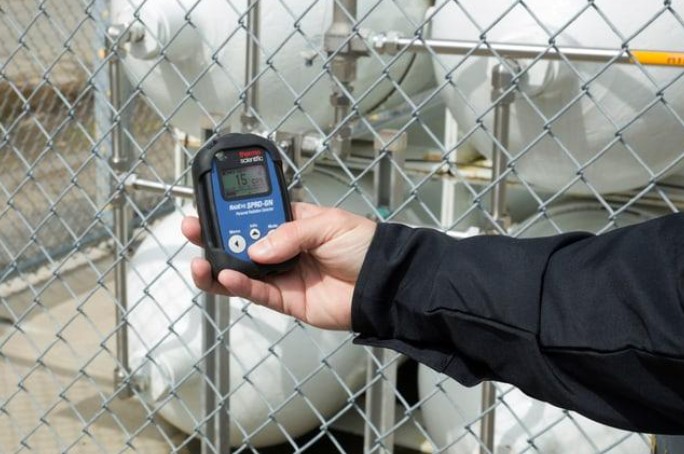
Photo: Thermo Fisher Scientific
Why Scientists Still Study Trinitite Today
Scientists study trinitite because it preserves evidence from the first atomic explosion. Its glass holds tiny traces of sand, metal, and radioactive material. These traces can help researchers understand how an explosion moved and mixed matter together. They can also help scientists learn how to identify debris after a nuclear event. This work is called nuclear forensics. It is rather like finding clues at the scene of a fire.
Trinitite has another kind of value. It marks the start of the atomic age. The Trinity test showed that the new bomb worked. Weeks later, atomic bombs were dropped on Hiroshima and Nagasaki, Japan. The war soon ended, but the world had changed. Nuclear weapons became part of world politics. Nuclear science also found uses in medicine and power generation. A small green fragment cannot tell that whole story. Still, it connects many changes to one place and one morning. Researchers continue to study the glass because it can still reveal details that earlier tools could not detect.
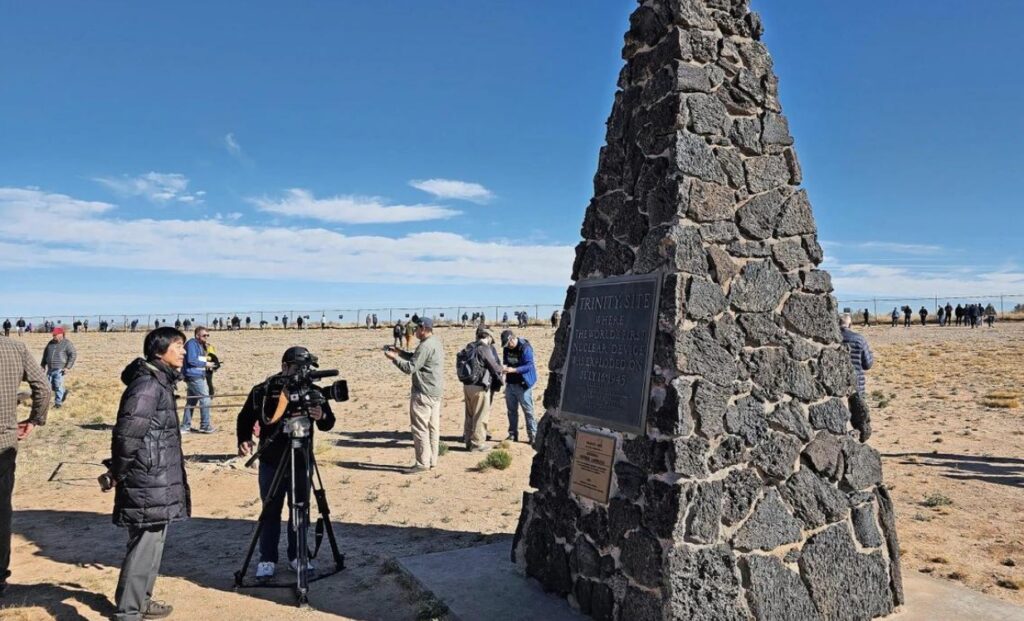
Photo: Thomas Farley
A Small Stone with a Long Shadow
Across the American West, old mines and railroads tell stories of change. Trinitite tells a different story. It began in one sudden flash in New Mexico. What looks like a bit of broken bottle glass is something else entirely. It holds sand from the desert and traces of a new human-created power. The glass did not choose what happened next. But it remains a quiet reminder that one morning in 1945 changed the world, and left a mark upon the ground.
- If you’re curious, here are more articles about interesting people, places, and things in New Mexico.
Discover more from TheCuriousOnlooker
Subscribe to get the latest posts sent to your email.

Really interesting, Frans. Thanks.
You’re welcome, Tom. I didn’t know the Trinity site at White Sands, New Mexico, allows visitors. That’s one thing I learned working on this article! Northern New Mexico is about 4 hrs drive for us. The Trinity site is an additional 5 hours farther south. While visiting is allowed, it’s only……once a year. I found this: https://home.army.mil/wsmr/contact/public-affairs-office/trinity-site-open-house
I know why the annual visiting day is in October: Temperatures are more moderate then. Much more conducive than the summer heat! For us, this is closer and the autumn colors in the area are stunning: https://thecuriousonlooker.com/history-of-the-cumbres-and-toltec-railroad/